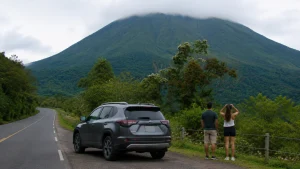

Do I need a 4×4 in Costa Rica? For most travelers, the honest answer is no — but the road to your hotel matters far more than the country name on the map. Costa Rica mixes modern highways with mountain access roads, rural gravel, steep hotel driveways and coastal routes that can change with the season. A compact car handles a mostly paved itinerary just fine, while an SUV or true 4×4 earns its keep the moment the final miles get rougher. This route-by-route guide helps U.S. and Canadian visitors match the vehicle to the destination, luggage and season, instead of paying for more capability than the trip actually needs.
4×4 Decision at a Glance
- San José, Central Valley, main resort corridors: a compact, sedan or crossover is usually enough
- Monteverde, rural Nicoya, hillside lodges: an SUV is a sensible baseline; 4×4 often adds real value
- Osa Peninsula, Drake Bay, Carate: a high-clearance 4×4 is the safer choice for driving access
- 4×4 never overrides the rental agreement: no rivers, lagoons or beach driving, regardless of the vehicle
- The final access road — not the destination name — should decide the vehicle category
Route-by-route detail, the full decision matrix and sources appear below — always confirm the final approach with your accommodation.
Do You Need a 4×4 for Costa Rica in General?
Not for every trip. If your itinerary stays on major paved roads — San José, the Central Valley, established Guanacaste resorts, La Fortuna or the Central Pacific — a sedan, crossover or 4×2 SUV is often enough. A 4×4 becomes more valuable once the plan includes steep rural access, unpaved mountain roads, remote beaches, the Osa Peninsula, or lodges whose final approach turns rough or changes in heavy rain.
The distinction that actually matters is between four-wheel drive and ground clearance. A crossover or 4×2 SUV can give a family extra clearance and luggage room without true four-wheel drive. A 4×4 sends power to all four wheels and adds traction on loose, steep or slippery surfaces — but it doesn’t turn an unsafe or prohibited road into an acceptable one.
Route by Route: What Vehicle Makes Sense?
San José, Central Valley and Major Paved Corridors
For city stays, airport transfers and travel mainly on established national highways, a compact, sedan or crossover is usually the most practical choice. Smaller vehicles are easier to park, more economical, and perfectly capable when the route and hotel access are paved. A 4×4 adds little here if the trip is primarily urban or highway-based.
La Fortuna, Arenal and Guanacaste Resort Areas
Most visitors traveling between the airports, La Fortuna and established beach-resort areas can get by with a crossover or SUV, without needing 4×4 traction. Extra ground clearance helps with comfort, luggage and the occasional uneven access road. If your accommodation sits outside the main tourism corridor, ask the property about the final stretch of road before choosing the vehicle.
Monteverde and Rural Mountain Lodging
Monteverde is where the decision gets more route- and hotel-dependent. Mountain approaches and final access roads can include steep, gravel or uneven sections. An SUV is a sensible baseline for comfort and clearance, while a 4×4 tends to pay off when the lodging is remote, the itinerary includes secondary roads, or travel falls during wetter months.
Nicoya Peninsula, Santa Teresa and Remote Beach Access
A 4×4 becomes easier to justify when exploring rural sections of the Nicoya Peninsula or staying somewhere reached by unpaved coastal roads. Conditions vary a lot by exact route and season, so the safer approach is to verify the final stretch with your hotel rather than assume every beach destination needs the same vehicle.
Manuel Antonio, Dominical and Uvita
The main Central and South Pacific tourism corridor is commonly drivable without a true 4×4. A crossover or SUV works well for families, luggage and side trips, and the need for 4×4 usually shows up at the final property-access road rather than on the main corridor itself. Villas and hillside lodges are worth a specific access check.
Osa Peninsula, Drake Bay and Carate
This is where vehicle choice matters most. Visit Costa Rica describes dirt-road access on parts of the Osa Peninsula, including routes toward Puerto Jiménez, Drake Bay and Carate. For travelers heading deeper into the peninsula, a high-clearance 4×4 is the more prudent category — though some visitors opt for a boat transfer to Drake Bay instead of driving the full approach. Always check current conditions before departure.
Scenario Matrix: A Quick Vehicle Decision
| Typical itinerary | Suggested vehicle | 4×4 needed? | Why | Pre-trip check |
|---|---|---|---|---|
| San José + Central Valley | Compact / sedan / crossover | Usually no | Mostly established paved travel | Parking, luggage, any San José driving restrictions |
| Arenal + Guanacaste resorts | Crossover / SUV | Route-dependent | Comfort and clearance usually matter more than traction | Confirm the final hotel access road |
| Monteverde + rural lodges | SUV / 4×4 | Often useful | Steep, gravel or uneven access is common | Check weather and property access |
| Santa Teresa / rural Nicoya | SUV / 4×4 | Often recommended | Seasonal and local road variability | Confirm the exact route with your hotel |
| Manuel Antonio + Uvita | Crossover / SUV | Usually optional | Main corridor is paved; hillside access can differ | Ask villas or lodges about their final road |
| Osa Peninsula / Drake Bay / Carate | High-clearance 4×4 | Strongly recommended | Official guidance notes dirt-road access | Verify current route status and transfer alternatives |
Road surfaces and closures can change with weather, construction and local conditions. Verify the final route with your accommodation and current official road information before you travel.
What Doesn’t a 4×4 Let You Do?
A common mistake is treating a 4×4 rental as permission to go off-road. amiGO’s current rental terms require the vehicle to be used within the contract conditions and exclude driving through rivers, lagoons, beaches or other prohibited areas. Costa Rica’s Ministry of Public Works and Transport has also reminded drivers that taking vehicles onto beach zones can be illegal.
- Don’t plan a river crossing just because a map app or social post shows a shortcut.
- Don’t drive on beaches simply because the vehicle has four-wheel drive.
- Don’t assume tire, undercarriage, towing or recovery damage is covered just because you rented an SUV.
- Only authorized drivers should operate the vehicle — the rental agreement still governs permitted use.
In other words, 4×4 capability is a tool for appropriate roads, not an invitation to test the vehicle’s limits. That distinction protects both the traveler and the rental contract.
How Should Families and Adventure Travelers Choose?
The best car for Costa Rica is the smallest category that comfortably fits your people, luggage and most demanding planned road. Families should count suitcases as carefully as seats — a five-passenger SUV may not comfortably carry five travelers plus large bags. Adventure travelers should prioritize ground clearance and traction only when their actual route calls for it.
Choose for the hardest segment: a family might spend most of the trip on paved roads but finish with a steep gravel approach to a lodge. In that case, the final access — not the longest highway stretch — should decide whether the booking is for a crossover or a 4×4.
amiGO’s current fleet spans compact cars, sedans, 4×2 crossovers and several 4×4 categories, including SUV and pickup options. That range makes it possible to match the vehicle to the itinerary instead of defaulting every visitor into the same category. Exact models and availability vary by travel dates and should be confirmed at booking.
Frequently Asked Questions
Do I need a 4×4 in Costa Rica? Not always. Major tourism corridors can often be driven in a compact, crossover or 4×2 SUV. A 4×4 is more useful for remote, steep, unpaved or seasonally challenging access.
Do I need a 4×4 for Monteverde? It depends on the exact approach, accommodation and season. An SUV is a useful baseline; 4×4 traction can add confidence on steeper or rougher secondary access roads.
What about the Osa Peninsula? If you plan to drive to more remote Osa destinations, a high-clearance 4×4 is the safer vehicle category. Official tourism information identifies dirt-road access on several Osa routes.
Can I cross rivers in a rental 4×4? Don’t assume so. amiGO’s current terms prohibit driving through rivers and similar areas, and doing so can affect coverage and responsibility.
Choose for the Hardest Part of Your Route
So, do you need a 4×4 in Costa Rica? The answer depends less on the destination name and more on the exact roads between the highway and your hotel, beach or trailhead. A compact or crossover can be ideal for a paved itinerary, while a 4×4 earns its cost when steep, unpaved or remote access shows up repeatedly in the trip. Check seasonal conditions, ask each accommodation about its final approach, and choose enough capability without automatically reaching for the biggest vehicle. The right match makes a Costa Rica road trip simpler, safer and more enjoyable.
Ready to Choose Your Vehicle?
Compare compact cars, crossovers and 4×4 options for your itinerary, confirm the current rental terms, and reserve directly through amiGO Rent a Car Costa Rica.